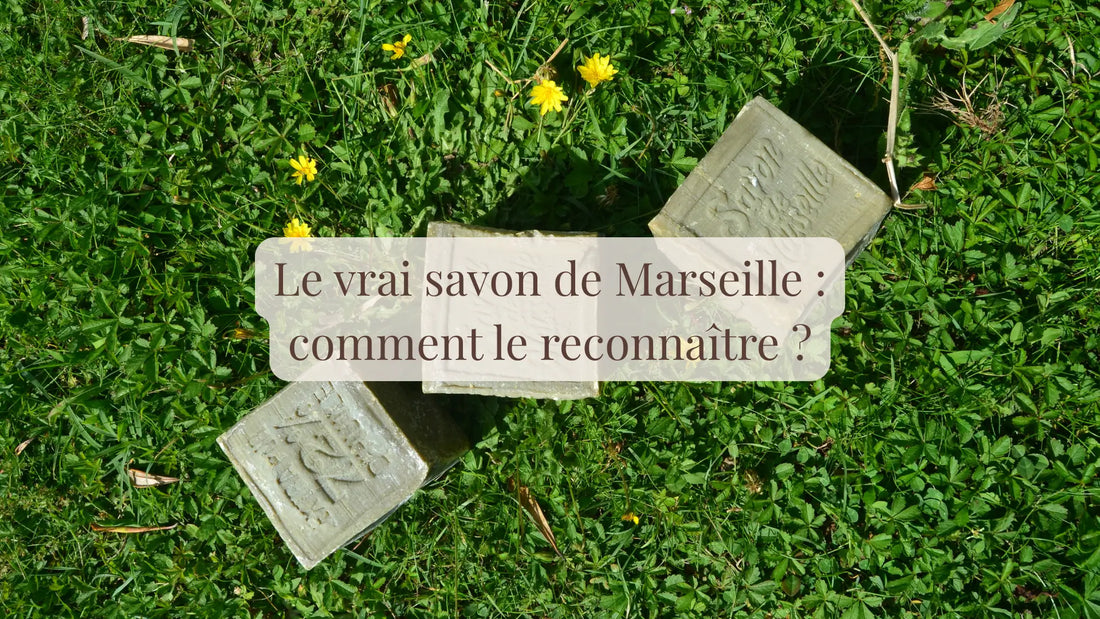
Real Marseille soap: how to recognize it?
Marseille soap is a true emblem of Provençal culture, particularly in the Bouches-du-Rhône region, born several centuries ago on the sunny shores of the Mediterranean. Known worldwide for its quality and authenticity, it embodies artisanal know-how passed down from generation to generation.
But today, this tradition is under threat: the name "Marseille soap" is not protected, allowing many manufacturers to sell industrial products under this name without respecting historical or composition criteria. The result? The market is flooded with fake soaps with dubious formulas and qualities far removed from those of the original.
In this article, we'll explore the origins, manufacturing process, and properties of authentic Marseille soap, while deconstructing the preconceived notions surrounding it. The goal? To help you make informed choices and recognize a soap worthy of the name.
What is a real Marseille soap?
Authentic Marseille soap is distinguished by its pure composition, its traditional manufacturing method, and its geographical origin. But given the misuse of its name, it is essential to know the criteria that allow it to be recognized with certainty.
A 100% natural composition, based on vegetable oils
Authentic Marseille soap is made exclusively from vegetable oils , without any added animal fat, colorings, perfumes, or preservatives. Historically, it was mainly made from olive oil , which gives it its beautiful green color and its nourishing properties for the skin. Today, other vegetable oils such as coconut or palm oil (from sustainable sources, in some cases) can also be used.
To be considered "traditional", it must contain at least 72% vegetable oils , a statement often engraved on the cubes themselves: "72% oil".

Manufactured using the Marseille process
The traditional manufacturing method, called the Marseille process , is based on 5 precise stages and takes place in a cauldron: mashing, salting, cooking, washing and liquidation.
This ancestral, very specific know-how guarantees a high-quality soap that is respectful of the skin and the environment.
The term “Savon de Marseille” is not protected… but there are some guidelines
As mentioned in the introduction, the name "Marseille soap" is not a protected designation of origin (PDO) , which allows many manufacturers to sell soaps that are very different from the original recipe.
Fortunately, there are some guidelines that can help you make the right choice:
- The green cockade of the Union of Marseille Soap Professionals (UPSM) : this logo guarantees manufacturing in a cauldron, in France, according to traditional criteria.
-
Recognized artisanal soap factories , such as:
- Le Sérail Soap Factory: www.savon-leserail.com
- Marius Fabre: www.marius-fabre.com
- The Fer à Cheval Soap Factory: savon-de-marseille.com
- The Savonnerie du Midi: www.savonneriedumidi.fr
These houses perpetuate the tradition and make their soaps in the Marseille region, according to the authentic process. They have also united to form Les Compagnons du savon to protect and promote the know-how of master soap makers and the quality of Marseille soap and all four are labeled EPV ( Entreprise d'un Patrimoine Vivant ).
Myths and Realities
Marseille soap, although iconic, is surrounded by many preconceived notions that cloud our understanding of the authentic product. It's time to sort out the truth from the lies!
“It has to be green to be real”
This is one of the most common misconceptions. Many people believe that only green soap made with olive oil is a true Marseille soap. In reality, the color varies depending on the oils used:
- Green or khaki: olive oil based (traditionally the most common)
- Beige or light brown : based on coconut or palm oil (also vegetable)
- White or cream : often used for laundry, with coconut oil or a mixture of vegetable oils
What matters most is not the color, but the composition and the method of manufacture . A Marseille soap can be perfectly authentic without being green.
“It doesn’t foam much, so it doesn’t wash well.”
Marseille soap has a fine, even discreet lather, especially compared to industrial shower gels enriched with synthetic foaming agents. But this does not mean that it is less effective.
On the contrary :
- Its richness in natural cleaning agents (notably plant fatty acids) makes it very effective for washing skin, hair or laundry.
- Less foam = fewer irritants , fewer endocrine disruptors , better dermatological tolerance .
Foam is a sensory criterion, not a guarantee of cleanliness .
“It’s necessarily organic.”
FALSE. Marseille soap is not automatically organic , even if it is often natural.
- It may contain vegetable oils not from organic farming , without being harmful.
- Only a soap certified by an organic label (Cosmos Organic, Ecocert, Nature & Progrès, etc.) guarantees the organic origin of the raw materials.
Beware of industrial formulations that use the name “Marseille soap” while adding synthetic perfumes, colorants or preservatives!!
In short, many beliefs about Marseille soap are based on myth or simplification. Knowing the true quality criteria allows you to consume better... and avoid false marketing promises.
Handcrafted vs. industrial manufacturing
Marseille soap is, above all, a skill, an art passed down from generation to generation. But at a time when industry seeks to produce quickly and cheaply, the quality and authenticity of this iconic soap are sometimes sacrificed. Understanding the difference between artisanal and industrial production also means learning how to choose a soap that respects both our skin and traditions.
The traditional method: a demanding and slow process
The true artisanal production of Marseille soap follows an ancestral process called the Marseille process or cauldron cooking . This process takes place in five stages, over a period of up to 10 days:
- Mashing : vegetable oils (especially olive oil) are mixed with soda and heated.
- Salting out : the paste is “washed” with salt water to remove impurities.
- Cooking : a long simmer over low heat in large pots.
- Washing : several rinses with pure water.
- Liquidation : the dough is rested then poured into molds.
The soap then air dries for several days. Over time, a thin white film may appear on the surface. These are actually simply salt crystals, a sign of authentic manufacturing.
This know-how, passed down by master soap makers, guarantees a pure soap, without additives, biodegradable, gentle on the skin and respectful of the environment.
Industry: Fast production, but at what cost?
In contrast, many so-called "Marseille" soaps are now manufactured industrially, sometimes even abroad. These rapid methods allow for mass production, but often at the expense of quality:
- Addition of animal fats or cheap palm oils .
- Synthetic perfumes , colorants , preservatives or other chemical additives integrated to seduce visually or olfactorily... but which have nothing to do with traditional soap.
- No cauldron cooking: the dough is cold pressed or mechanically molded.
These industrial soaps can be irritating, less effective, and, above all, misleading for consumers. They take advantage of the Marseille soap brand image without respecting its ethics or methods.
A difference in quality... and values
Choosing an artisanal Marseille soap means:
- Encourage local crafts and committed businesses (such as Savonnerie Le Sérail, Fer à Cheval, Marius Fabre, du Midi as explained above)
- Offer your skin a natural, gentle product, without controversial substances
- Reduce your environmental impact (no plastic, no chemical pollution)
- Participate in the preservation of a living heritage
In short: not all Marseille soaps are equal . Behind an identical name, there can be a world of difference.
Properties and uses
Marseille soap isn't just an iconic product; it's also a valuable everyday ally, with multiple virtues and uses. Its richness lies in its simplicity, its natural composition, and its versatility.
Dermatological virtues
Thanks to its gentle formula, without perfume or synthetic additives, real Marseille soap is particularly recommended for sensitive, allergic or reactive skin . Rich in vegetable oil (especially olive), it moisturizes and protects the epidermis while cleansing effectively. It is often recommended by dermatologists , particularly in cases of eczema, acne or atopic skin.
Used in daily care, it can be used as a soap for the face, body and even for intimate hygiene , provided that it is well formulated using only vegetable oils.
Home applications
It is undoubtedly one of the only soaps capable of replacing many household products on its own :
- Washing clothes : grated, it becomes a natural and economical homemade laundry detergent.
- Handwashing : effective degreaser without chemicals.
- Multi-purpose cleaner : in blocks or shavings, it cleans surfaces, brushes, walls, tiles, etc.
- Fabric stain remover : removes the toughest stains (grease, blood, grass) before washing in the washing machine.
- Natural moth repellent : placed in a cupboard, it repels unwanted insects without harming your health.
- Extra shampoo : it can even be used to wash hair in an emergency or when traveling.
Ecological benefits
Marseille soap is also a zero-waste product par excellence. Solid, durable and biodegradable, it does not generate plastic bottles or water pollution . Unlike conventional detergents, its chemical-free formulation respects waterways, aquatic fauna and groundwater .
It is also a multi-purpose product, which allows you to considerably reduce the number of cleaning or toiletry products needed on a daily basis. This reasoned minimalism makes it a must-have in an eco-responsible approach.
How to recognize an authentic Marseille soap?
At a time when the market is saturated with counterfeits and imitations, knowing how to recognize a genuine Marseille soap is essential. In the absence of a protected designation of origin, historic artisanal brands and certain distinctive signs remain your best guides for making an informed choice.
The criteria to know
A real Marseille soap:
- Contains only vegetable oils , notably olive oil (or sometimes copra or palm oil according to tradition, but be careful about the origin of these oils).
- Contains no coloring , perfume , preservative or chemical additive .
- Must respect the traditional composition : at least 72% vegetable oils (often indicated on the soap itself).
- It is generally made in a cauldron , using the Marseille process , as explained above.
- Often has an engraved weight (e.g. 300g, 600g), a distinctive sign of authentic breads.
- It is cubic or rectangular in shape , without plastic packaging, with a rustic appearance.

The mentions to be examined
- INCI ( International Nomenclature of Cosmetic Ingredients ) : the list of ingredients must be clear, short and compliant with regulations. For a traditional Marseille soap, we often find:
- No fragrance : Beware of "Marseille" soaps that smell of lavender, rose, or cherry. These are not traditional Marseille soaps!
- Trusted labels : Some soap factories bear the green badge created by the Union of Marseille Soap Professionals (UPSM). This label guarantees compliance with the original recipe.
My recommendations
On Le sens des choses , I offer the real Marseille soap from Savonnerie Le Sérail , one of the last artisanal Marseille soap factories to continue manufacturing in a cauldron.

I also offer a stain remover with Marseille soap and bicarbonate , perfect for laundry and stubborn stains, always developed by Le Sérail, a guarantee of authenticity!

Let’s preserve the authenticity of Marseille soap!
In this article, we shed light on the many gray areas surrounding Marseille soap. Behind its apparent simplicity lies an ancestral product, the result of rigorous expertise, with multiple uses and recognized dermatological benefits.
However, since the name "Savon de Marseille" is not protected, the market is now saturated with industrial counterfeits, often perfumed, colored, or enriched with controversial ingredients. Hence the importance of learning to recognize an authentic Marseille soap: vegetable composition, cauldron manufacturing, absence of perfume, engraved weight, clear information on the INCI list, etc.
As responsible consumers, choosing a truly artisanal soap, like those produced by Savonnerie Le Sérail , not only means preserving our skin and our planet, but also supporting an entire part of French heritage . By choosing an authentic soap, you are helping to perpetuate a threatened local craft, promoting short supply chains and encouraging more ethical consumption.
Long live Marseille soap!
Sources:
www.savon-de-marseille-traditionnel.fr
www.savon-leserail.com
www.marius-fabre.com
savon-de-marseille.com
www.savonneriedumidi.fr